Buying & Collecting / Know the numbers
Read the numbers.
Know your watch.
How to use a timegrapher—and understand what its readings mean before you buy a mechanical watch. A near-zero daily rate is only one part of the story.
These are general screening guidelines for conventional mechanical movements. The exact caliber, winding state, test position, temperature, and equipment settings matter. Manufacturer specifications take priority. Ordinary acoustic timegraphers are not a universal test for quartz, tuning-fork, Spring Drive, or unusual escapements.
01 / Start with a reliable reading
Set up before you judge.
Identify the movement.
Find the caliber’s beat rate, lift angle, and manufacturer testing specifications. A familiar brand name does not identify the movement inside.
Wind appropriately.
Follow the watch’s instructions. For hand-winding movements, stop at normal resistance. Some older automatics cannot be wound at the crown. Record the winding state and compare readings under matching conditions.
Place the watch securely.
Start dial up with the crown in its normal running position. Use the holder as instructed, ensure good microphone contact, and keep the area quiet. Avoid touching the holder during measurement.
Confirm the beat rate and lift angle.
Automatic beat detection is convenient, but check that it matches the movement. Lift angle is an input used to calculate amplitude, not a health score. The common 52° default is not right for every movement; an incorrect value can make amplitude misleading.
Let it settle and record.
Allow stabilization and watch a sustained trace rather than photographing the first reading. Around 30–60 seconds per position is a practical starting point; follow your equipment’s instructions. Record rate, amplitude, beat error, position, lift angle, and winding state.
Repeat in several positions.
Try dial up, dial down, and crown down. Let each reading settle. Some differences are normal, and amplitude is usually lower upright. Large or unstable changes warrant investigation against the caliber’s specifications.
02 / The three main readings
What is good? What needs questions?
| Reading | Meaning | Practical interpretation |
|---|---|---|
| Rate / s per day | Estimated daily gain or loss at the rate measured during this test. +8 gains; −8 loses. | Closer to zero is generally desirable. Compare with the movement’s specification; there is no single acceptable rate for every watch. This is not a promise of wrist accuracy. |
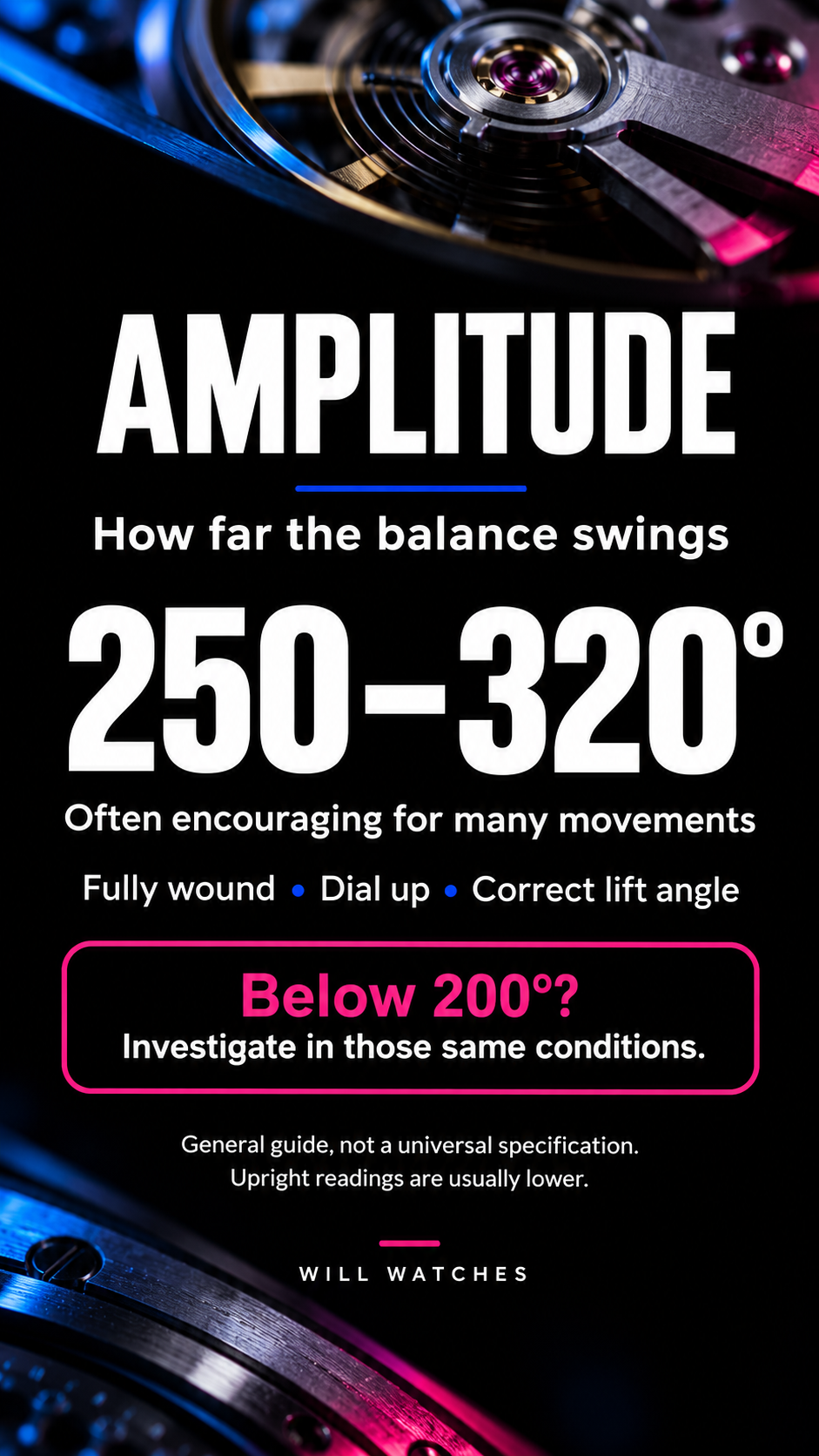
| Amplitude / degrees | The balance’s angular swing from its resting position to one extreme. | Roughly 250–320° at full wind, dial up, is often encouraging for many conventional movements. Under 200° in those same conditions warrants investigation. Some calibers run lower by design. Excessively high amplitude can also be problematic. |
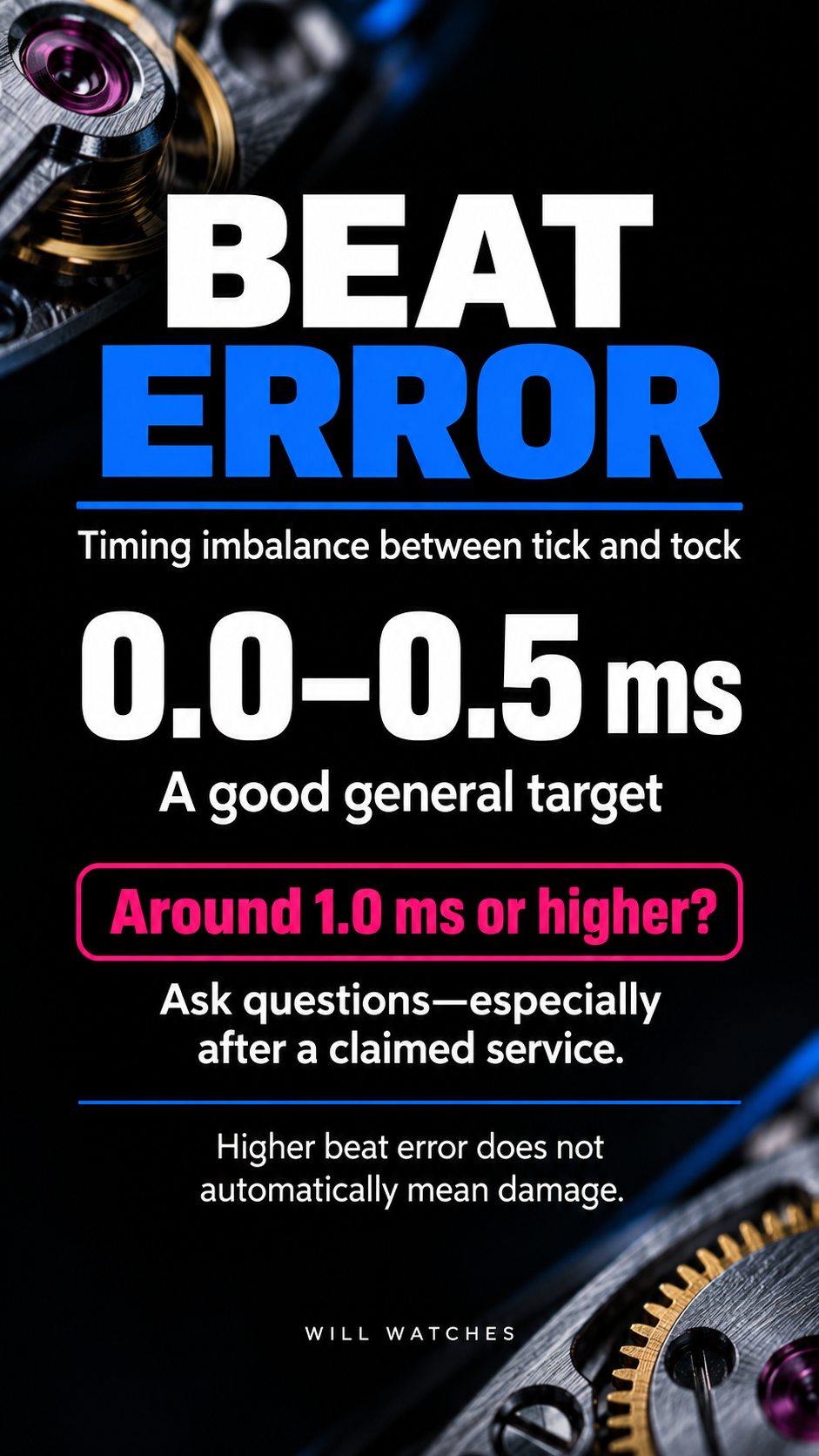
| Beat error / milliseconds | Timing asymmetry between tick and tock. | 0.0–0.5 ms is a good general target. Around 1.0 ms or more deserves questions, especially after a claimed service. It does not automatically mean damage or establish the repair required. |
A vintage movement may have different expectations from a modern caliber. A low reading can reflect insufficient winding, wrong settings, or a mechanical problem. Retest correctly before drawing conclusions; a single number cannot identify the cause.
03 / Read the pattern
The lines tell a story, too.
- A tidy, consistent trace
Encouraging stability during the test. A clean line can still slope because the watch is gaining or losing time.
- Scattered dots or wandering lines
Check microphone contact, watch placement, gain, background noise, and beat detection first. If instability persists, further assessment is warranted.
- Two lines are not an automatic failure.
Beat error, display scale, and signal pickup affect trace appearance. Read the measured values and consider the whole pattern.
- Stability matters across positions.
A good number in one position can hide a large variation elsewhere. Do not average away concerning behavior without understanding it.
04 / Before you buy
Do not judge by rate alone.
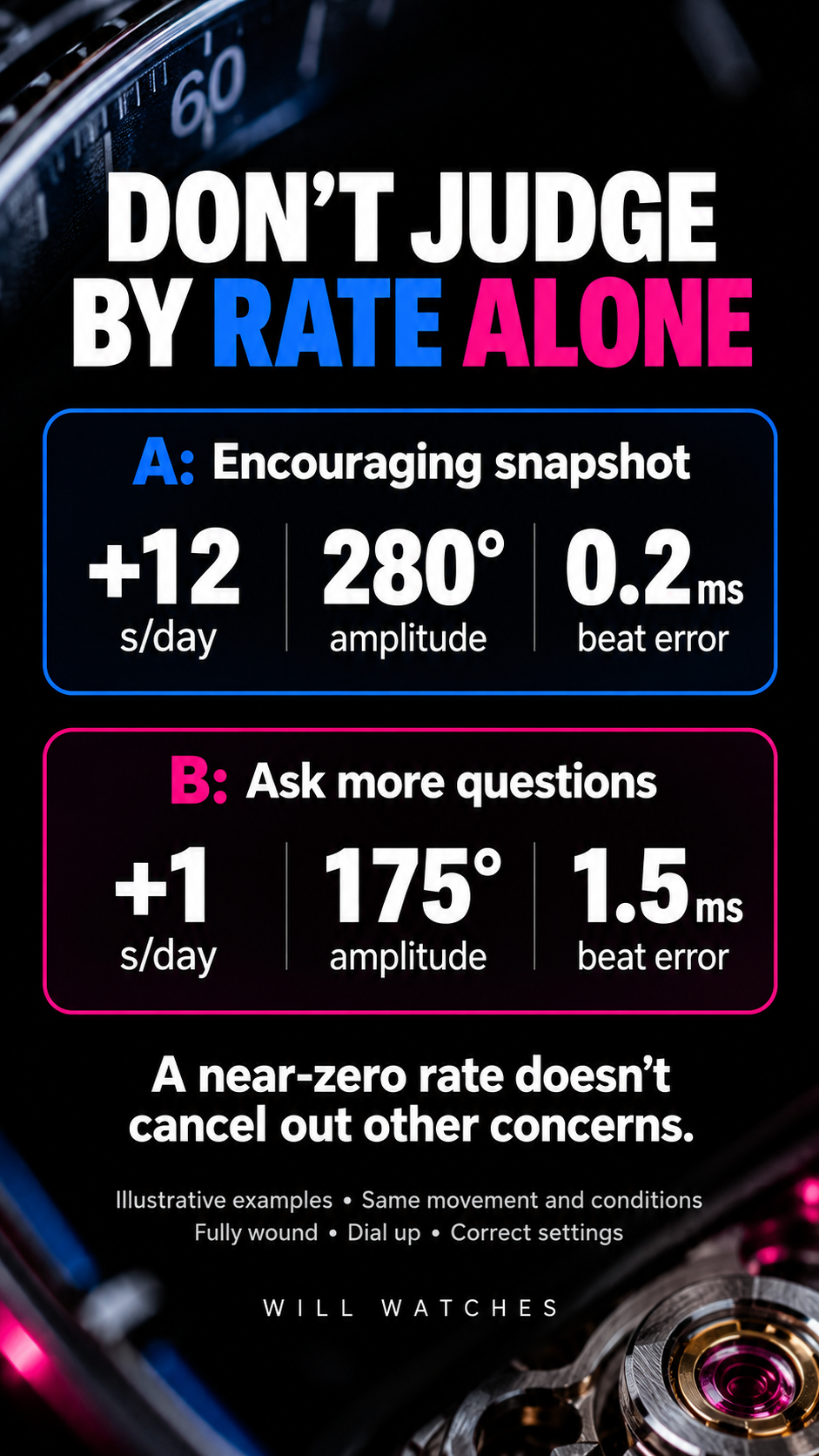
Compare these illustrative readings for the same conventional movement under matching conditions: full wind, dial up, correct settings.
| Example | Rate | Amplitude | Beat error | Takeaway |
|---|---|---|---|---|
| A | +12 s/day | 280° | 0.2 ms | Encouraging snapshot. Check specifications and other positions. |
| B | +1 s/day | 175° | 1.5 ms | A near-zero rate does not cancel out the other concerns. Investigate. |
Ask the seller:
- What exact movement is inside?
- Was the watch fully wound, and when?
- What position was used, and was the correct lift angle entered?
- Can you show a settled reading or short video in several positions?
- Is there documented service history, including the date and work performed?
A timegrapher does not prove authenticity, establish service history, test calendar or winding functions, measure power reserve by itself, or certify water resistance. Combine readings with condition, documentation, functional checks, and a watchmaker’s assessment where appropriate.
05 / Keep these handy
Your quick-reference cards.
Tap a slide to open the full-size image. Save it for your next listing or bench session. The ranges are general guides, not universal pass-or-fail specifications.

Further reading: Witschi: Testing Methods for Mechanical Watches · Grand Seiko: test accuracy versus normal use. Always consult the exact movement’s technical instructions.